

An AI voice agent tells a caller their appointment has moved to Thursday. The caller hangs up. The dashboard shows no transfer, but the booking system still shows Tuesday.
To measure AI voice agent resolution, define what success looks like for each request and check the evidence that confirms it. Track transfers, abandoned calls and unknown outcomes separately so you can see what happened after the agent answered.
Define what counts as resolved
For an appointment change, success means the correct appointment was updated and the caller received the new time. For a delivery enquiry, it means the caller received the current delivery status for the correct order. The evidence will differ by task. An appointment change can be checked against the booking system. An answer about business hours can be reviewed against the approved information the agent should use.
Start with a few high-volume call reasons. For each one, write down the intended result, where reviewers can verify it, and what the agent should do if that evidence is unavailable. Include cases where the system returns an error after the agent has already told the customer what it intends to do.
Record how the AI interaction ended
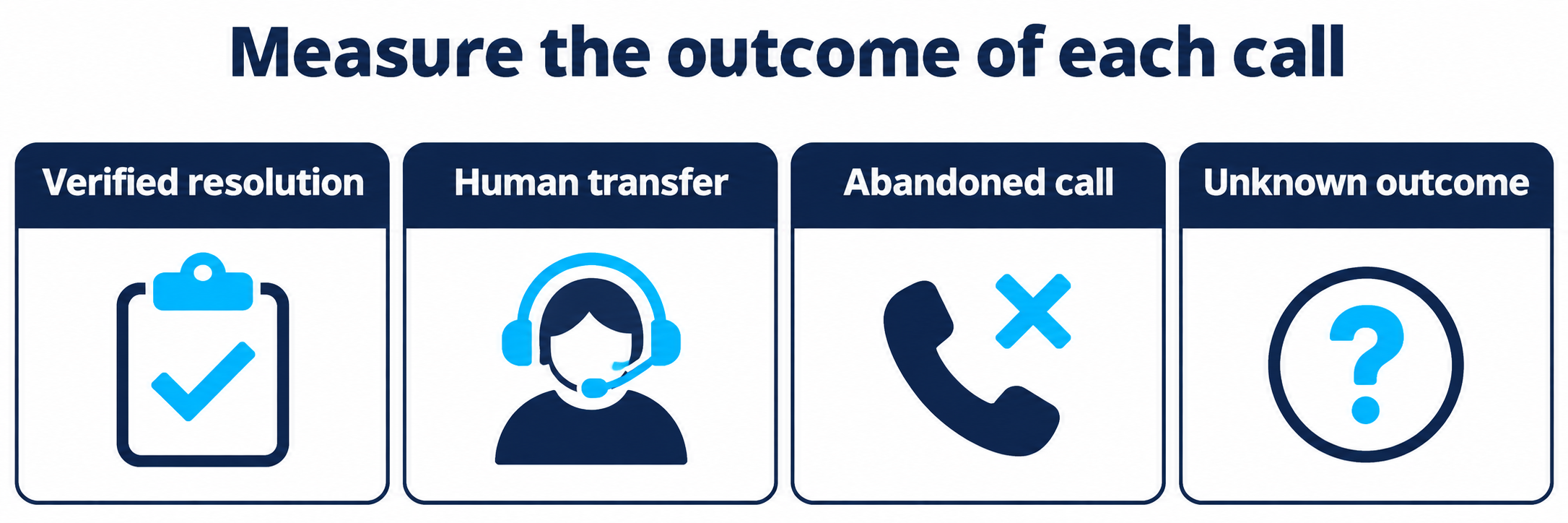
Use one primary outcome for the AI portion of the call and keep the final customer outcome in a separate field.
| AI outcome | What to record |
|---|---|
| Verified resolution | Evidence that the AI completed the caller’s request, such as a confirmed booking update |
| Human transfer | Whether the transfer connected and which queue received the call |
| Abandoned call | Where the caller left before completion could be verified |
| Unknown outcome | What evidence is missing and how the team can check it |
Add an explicit failure category for cases where you know the task failed. For calls with several requests, track each request separately if your reporting allows it. If you report at call level, define how you handle partial completion before you calculate a rate.
A transfer can be the correct outcome for the AI. If a colleague completes the request during the same call, record that separately as a first-contact resolution under your reporting rules. Amazon Connect is one example of a platform that distinguishes case resolution from contact-level activity. Amazon Connect case metrics
Keep the denominator visible
For a pilot, divide verified AI resolutions by eligible calls assigned to the AI, using a documented eligibility rule. Keep failed, abandoned and unknown calls in the denominator when they met that rule. List genuine exclusions, such as internal test calls, separately so readers can reproduce the result.
Suppose 100 eligible calls produced 58 verified AI resolutions, 24 transfers, 10 abandonments and 8 unknown outcomes. The verified AI resolution rate is 58%. If colleagues resolved 15 of the transferred requests during those same calls, 73 of the 100 requests were verified as resolved on the first contact in this simplified example. Each call in the example contains one request. The two figures answer different questions and help the team decide what to investigate.
Look for repeat contact about the same issue
An appointment can appear resolved until the customer calls back because the confirmation never arrived. Agree on an observation window appropriate to each task, such as 48 hours for a simple booking change, and compare calls only after that window has elapsed.
Use a case or order reference where available. A repeat call from the same phone number may concern a different issue, and a customer may return through another channel. If a match is uncertain, keep it unclassified and show how many calls you could match confidently. Record same-issue recontacts separately so you can see which apparent resolutions needed further work.
Use the results to decide what to change
Break down outcomes by call reason and review a sample with the team that handles that work. If booking changes generate repeat calls while business-hours enquiries resolve cleanly, inspect the booking confirmation and update steps before expanding automation. Review a sample of reported successes as well as failed calls to catch cases where the two systems disagree.
KCM Telecom’s trial form lets you specify AI call agents, AI reports and CRM integration as requirements. Bring a shortlist of call reasons and examples of the evidence you want to verify. AI agent prices are on request, depending on complexity. KCM Telecom trial and requirements form
Planning your next customer communications project? Contact KCM Telecom to discuss your requirements. You can test our Voice Agents by calling (+357) 25 056432 or test our services 30 days free of charge inclusive max. 100 EUR call credit!