

A caller starts in English, asks to continue in another language, then reads out an order reference. The AI voice agent sounds fluent, but it drops the first digit of the reference. The caller reaches the right department and still has to explain everything again.
To test a multilingual AI voice agent, run complete calls through the phone system you plan to use. Check whether callers can choose or change language, whether critical details survive the switch, and whether the receiving team gets enough information to continue the conversation.
Decide how callers choose a language
Start with the languages your team can support from greeting through resolution. For each language, identify which requests the agent can handle, which knowledge it can use and where it should transfer callers who need help.
An explicit language choice can be useful when callers open with a brief greeting or a business name. Automatic detection can also work with a defined list of languages. Google Cloud’s speech recognition documentation, for example, describes a configuration that selects from supplied languages and recommends limiting the list to those needed. That example describes the speech recognition component. Your pilot still needs to check the behaviour of the complete phone workflow. Google Cloud language recognition documentation
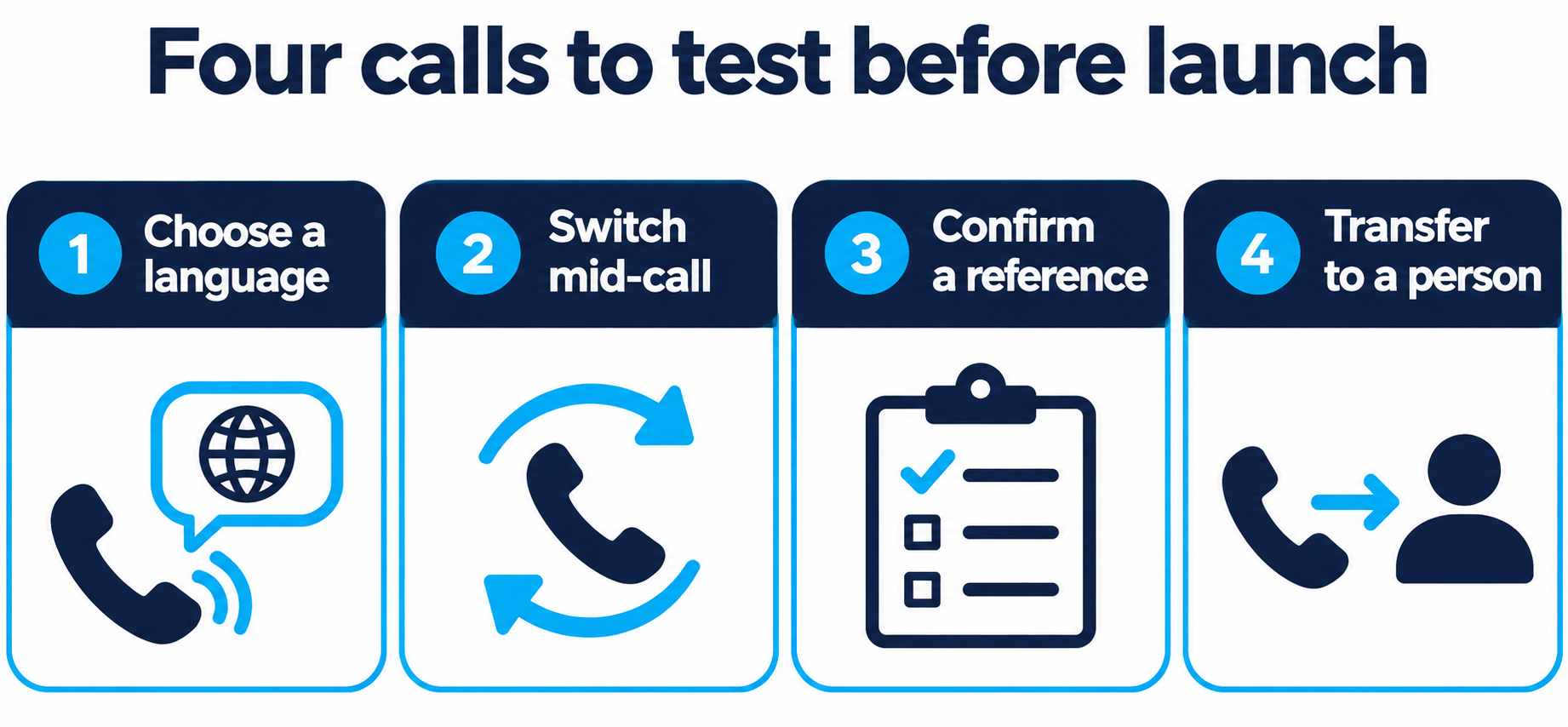
Run four calls before launch
Use a real phone line and fictional customer records. Ask speakers to vary their pace, accent and phrasing, and repeat the same scenarios with ordinary background noise. Start with these four calls.
- Choose a language. Open with a short greeting, then ask for your preferred language. Check whether the agent confirms your choice and continues the task in that language.
- Switch mid-call. Begin a request in one language, provide a detail, then explicitly ask to continue in another. Check whether the agent carries forward the request and the details already confirmed.
- Confirm a reference. Give a fictional reference such as
AB-0074, then correct one character. Check what the agent reads back and what the connected system actually saves. Include names with unfamiliar spellings and numbers spoken in groups. - Transfer to a person. Ask for a colleague who speaks the selected language. Check which queue receives the call and what context the colleague receives. Repeat the call outside that queue’s staffed hours and check whether the caller hears an accurate next step.
Score the outcome of the call
For every test, record the requested language, task, expected result, actual result and any repeat questions. Give the reviewer a simple choice of pass, fail or blocked. Use “blocked” when a dependency, such as the receiving queue or test record, prevents you from verifying the outcome.
A successful reference lookup should return the intended record and preserve the confirmed identifier. A successful transfer should reach the intended queue and give the receiving colleague the language preference, reason for calling and any confirmed details they need. If the caller asks for a language you cannot support, test whether the agent explains the available options clearly.
Review results by language and task. An average across all calls can hide repeated failures in one workflow. Agree in advance which failures should hold up rollout. Saving the wrong reference or routing callers to an unstaffed queue are good candidates for a fix and retest before launch.
Give the pilot a clear scope
Share your priority languages, call scenarios, operating hours, handoff destinations and any systems the agent needs to use. Decide what the agent should do when it is unsure, when the caller corrects it, and when the receiving team is unavailable.
KCM Telecom’s trial form lets you specify AI call agents and CRM integration as requirements. Discuss the languages, workflows and integrations you want to test with the team. AI agent prices are on request, depending on complexity. KCM Telecom trial and requirements form
Planning your next customer communications project? Contact KCM Telecom to discuss your requirements. You can test our Voice Agents by calling (+357) 25 056432 or test our services 30 days free of charge inclusive max. 100 EUR call credit!