

A cloud phone system does not remove the need for a continuity plan. If your office internet fails, business calls may still reach another location or a mobile app—but only if the remaining services and routing are available.
Business phone failover means moving call handling to an alternative path when the normal path is unavailable. The practical question is simple: what will a customer experience when part of your setup stops working?
Start with the failure, then choose the fallback
An internet outage, a power cut and an unavailable PBX are different problems. A second connection may restore office access, but it cannot repair an unavailable phone platform. Likewise, a provider-side diversion cannot power an office router.
Map the chain from your business number through the SIP trunk and PBX to the person answering. Identify which parts share a connection, power supply or physical location.
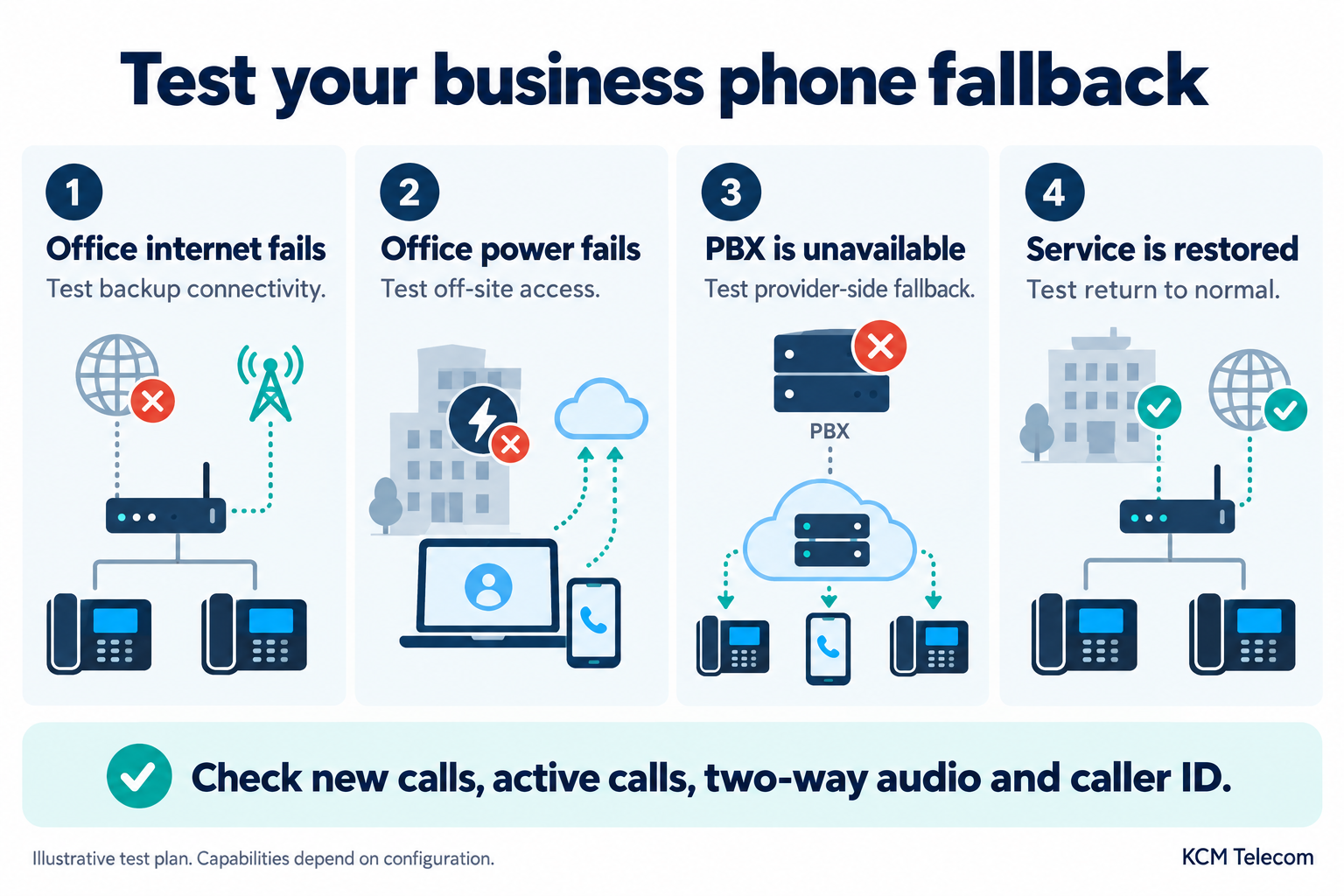
| Scenario | Fallback to assess | What to verify |
|---|---|---|
| Office internet fails | Backup connection or an off-site user | The PBX remains reachable and calls have two-way audio |
| Office power fails | Appropriately sized backup power and off-site access | Router, phones and supporting equipment are covered |
| PBX becomes unavailable | Supported standby system or provider-side routing | The fallback can operate independently of the failed PBX |
| Service returns | A controlled return to normal routing | No forwarding loops, abandoned queues or missed follow-ups |
A backup connection is only one part of the plan
A router may switch to a second internet service while phones still need time to reconnect. Existing calls and new calls can behave differently. Test both rather than assuming a successful internet speed test proves business calling works.
Check incoming calls, outgoing calls, transfers and two-way audio. Confirm that the intended business caller ID is presented and that your fallback has enough capacity for the people who need it.
Consider shared dependencies too. Two connections using the same powered router, building entry point or underlying access network may leave a common failure point.
Put fallback routing where it can still work
If diversion depends entirely on the PBX that has failed, it may never run. Ask where the fallback decision happens and what it needs to remain available.
As a technical example, Twilio documents multiple SIP delivery destinations with priorities. Its failover guidance also describes a separate recovery application if configured destinations cannot be reached. These illustrate different continuity layers; they do not establish how every KCM installation is configured.
A standby PBX is another design choice. 3CX documents an active-passive approach with specific licensing and deployment requirements. Confirm the capabilities supported by your selected platform and service.
Build continuity around the people answering
A call reaching a mobile phone is useful only if someone can take responsibility. Agree who answers during an incident, which enquiries take priority and how messages become assigned follow-ups.
If an AI receptionist is part of your design, include its dependencies in the same review. The AI platform, business applications and escalation destination must be available for the intended workflow to complete. An AI agent is not a substitute for a tested fallback route.
Review the complete setup with KCM Telecom
KCM’s SIP trunk service describes backup routing and monitoring. Its PBX feature comparison lists apps, call-handling tools and failover-related capabilities across its service options.
Use that as the starting point for a practical review: which failures does your proposed setup cover, where do calls go, and which features require a particular package or configuration? Include fallback call charges and any additional connectivity or equipment in the proposal.
Run a controlled test before an outage chooses the timing
Agree a test window with your provider and IT team. Record the expected destination, responsible person and recovery steps. Test an incoming call, an outgoing call and a transfer while each agreed failure scenario is simulated safely.
Measure the time until a new call can be answered, note what happens to active calls, and confirm normal routing after recovery. Keep the results and repeat the test after significant changes to connectivity, routing or the PBX.
A useful continuity plan names the fallback, proves it works and gives someone ownership of the next call.
Planning your next customer communications project? Contact KCM Telecom to discuss your requirements. You can test our Voice Agents by calling (+357) 25 056432 or test our services 30 days free of charge inclusive max. 100 EUR call credit!